February 2, 2026 – A new study reveals a simple and fast, label-free way to distinguish aggressive cancer cells by how they physically behave. Researchers at the Hebrew University of Jerusalem have developed a novel way to identify aggressive cancer cells, not by analyzing their genes or chemical markers, but by observing how they physically interact with their environment.
The research, published in Materials Today Bio, was led by Ph.D. Student Chalom Zemmour under the mentorship of Prof. Ofra Benny from the School of Pharmacy at the Hebrew University. It introduces a new technology that uses specially designed microscopic, pattered surfaces to act as a kind of “mechanical sensor” for cancer aggressiveness.
Watching cancer cells reveal their true nature
Cancer cells are typically classified using molecular and genetic tests. While powerful, these methods can be expensive, time-consuming, and sometimes fail to capture how dangerous a cell truly is. Aggressive cancer cells, those capable of spreading to other organs, often look similar to less harmful cells under standard laboratory conditions.
The new method takes a different approach.
Instead of asking what molecules cancer cells express, the researchers asked: how do cancer cells behave physically when interacting with their environment?
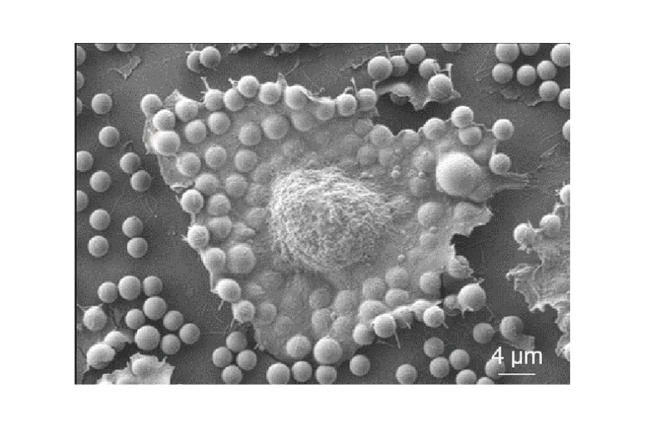
To answer this, the team created special surfaces patterned with tiny plastic beads, creating nano and micro topographies. Thousands of times smaller than a grain of sand, forming a textured landscape invisible to the naked eye. When cancer cells are placed on these surfaces, their behavior changes depending on their aggressiveness.
More aggressive cancer cells:
- Grip the surface more strongly
- Swallow more of the microscopic particles
- Stretch and wrap themselves around the tiny features
Less aggressive cells behave very differently—even though these differences are undetectable on ordinary flat lab surfaces.
A new window into metastasis
The study also revealed something unexpected about metastasis, the process by which cancer spreads.
The researchers found that the special surfaces could differentiate between cells with varying metastatic stages, as occurs in the body, where cancer cells temporarily lose their ability to strongly adhere after leaving the primary tumor, possibly helping them travel through the body. Once they reach a new site, however, they regain strong adhesion and mechanical activity.
“This tells us that aggressiveness is not a fixed trait, and we can have sensitive technology to measure it,” explains Prof. Benny. “It’s a functional state that can be revealed through physical behavior, not just molecular signatures.”
Simple, accessible, and potentially clinical
One of the major advantages of the new method is its simplicity. It does not require dyes, labels, or complex genetic analysis. The surfaces can be produced using standard laboratory techniques and are compatible with imaging and molecular tests already used in research and clinical labs.
Because of this, the technology could eventually be adapted for:
- Rapid screening of cancer cell aggressiveness
- Research on metastasis and tumor progression
- Drug testing and personalized cancer treatment
Rethinking how we identify dangerous cancer
The study highlights a growing shift in cancer research—moving beyond purely molecular analysis toward functional and mechanical characteristics of cells.
“Our work shows how cancer cells push, pull, and grip their surroundings can tell us a great deal about how dangerous they are,” says Prof. Benny. “This opens a new path for cancer diagnostics that is both powerful and surprisingly simple.”
The research paper titled “Colloid-patterned surfaces distinguish malignant mechanophenotypes” is now available in Materials Today Bio and can be accessed here.
Researchers:
Chalom Zemmour1,2, Mor Ozeri1, Ora T. Cohen1, Eduard Berenshtein3, Zakhariya Manevitch3, Yael Feinstein-Rotkopf3, Irit Rosenhek-Goldian4, Hadar Benyamini5, Victor Shelukhin2, Ofra Benny1
Institutions:
- Institute for Drug Research, School of Pharmacy, Faculty of Medicine, The Hebrew University of Jerusalem
- Center for Nanoscience and Nanotechnology, The Hebrew University of Jerusalem
- Core Research Facility, Faculty of Medicine, The Hebrew University of Jerusalem
- Department of Chemical Research Support, Weizmann Institute of Science
- Bioinformatics Unit of the I-CORE, Faculty of Medicine, The Hebrew University of Jerusalem












Advancing the Next Phase of Development of the Henrietta Szold Hadassah – Hebrew University School of Nursing
March 16, 2026 – The Henrietta Szold Hadassah – Hebrew University School of Nursing (Henrietta Szold SON), together with the Hadassah Women’s Zionist Organization of America (HWZOA), the Hebrew University of Jerusalem (HU), and the Hadassah Medical Organization

300 Million Years of Hidden Genetic Instructions Shaping Plant Evolution Revealed
March 16, 2026 – The DNA of every organism contains both genes and instructions that determine when and where those genes are switched on. Genes are relatively easy to recognize, like the corner pieces of a puzzle; they have telltale features that stand out. But the regulatory DNA that
New Technique Combines Multimode Lasers, Which Could Improve Optical Communications and Photonic Applications
March 16, 2026 – A 3D-printed optical breakthrough that efficiently combines light from dozens of small semiconductor lasers into a single multimode optical fiber with very low loss has been achieved by researchers at the Hebrew University of Jerusalem (HU). In the new study, published