
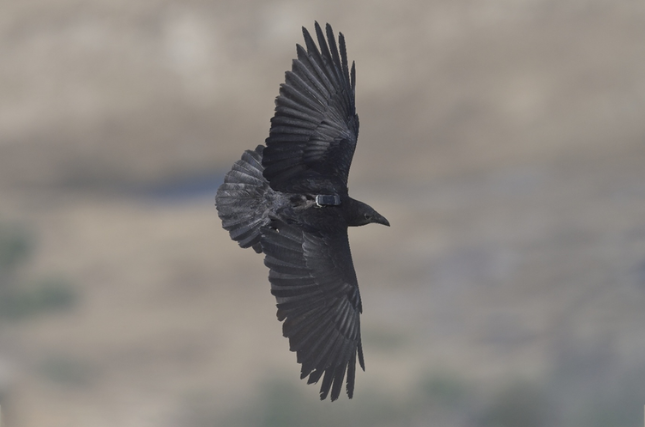
April 23, 2026 – Along the stark and shimmering coastline of the Dead Sea, where desert cliffs meet one of the world’s most extreme environments, a quiet drama is unfolding in the skies above. Fan-tailed ravens, intelligent, adaptable, and ever-watchful, are making life-or-death decisions every day. And according to new research, those decisions may come down to personality.
In a new study led by Dr. Miguel Guinea and Prof. Ran Nathan of the Hebrew University of Jerusalem (HU), in collaboration with Prof. Thomas Bugnyar of the University of Vienna (Austria) and Prof. Joah Madden of the University of Exeter (UK), researchers reveal how consistent individual behavioral differences, often referred to as “animal personality”, shape how wild animals respond to the rapidly expanding footprint of human activity. As tourism, infrastructure, and development continue to encroach on natural habitats worldwide, animals are increasingly forced to navigate unfamiliar and often risky environments. The new study reveals that not all individuals respond the same way, and those differences can have profound consequences for survival.
Combining controlled laboratory experiments with cutting-edge GPS tracking in the wild, the research team followed fan-tailed ravens (Corvus rhipidurus) living along Israel’s Dead Sea coastline. In the lab, researchers tested ravens’ tendency to take risks across different contexts: a tendency to approach unfamiliar objects, forage for unfamiliar food items, and, in proximity to humans, make use of new environments. These contexts were selected as representative of the environmental changes ravens have experienced in their natural habitat due to the expansion of human activities.
What emerged was striking: individual ravens not only consistently avoided (or took) risks in the same contexts but also across all contexts. Individuals that were willing to eat unfamiliar food items were willing to approach novel objects, forage in proximity of humans, and make use of new environmental structures, while others simply avoided all potential risks.
But the real revelation came when these personalities were tracked in the wild.
Using high-resolution GPS data, the researchers discovered that these behavioral differences became even more pronounced in natural settings. Risk-prone ravens tended to linger near tourist areas, taking advantage of easy food sources but exposing themselves to greater danger. In contrast, risk-averse individuals avoided human activity, ranging farther across the landscape and foraging at the edges of their territories.
The consequences of these choices were stark.
Over extended monitoring periods, risk-averse ravens were significantly more likely to survive than their bolder counterparts. While risk-taking may offer short-term rewards, such as access to food near humans, it appears to come at a long-term cost.
“Our findings show that consistent behavioral traits are not just quirks; they can determine life or death,” said Dr. Miguel Guinea. “This is particularly crucial for fan-tailed ravens in the Dead Sea, a population declining so rapidly that it may soon disappear from the region.”
Prof. Ran Nathan added, “This study highlights how integrating lab-based behavioral assays with real-world movement data can reveal patterns we would otherwise miss. It’s a powerful approach for understanding how animals cope with human-driven environmental change.”
As anthropogenic pressures intensify across the globe, the study suggests that variation in risk-taking behavior could play a critical role in determining which individuals and populations persist.
Since wildlife responses to human activity are not uniform, studies examining how different populations of wild animals respond to anthropogenic changes are essential. Wild animals in cities tend to show bolder traits than their counterparts in natural habitats. In the Dead Sea, however, human-driven environmental changes appear to have occurred too rapidly for fan-tailed ravens to adapt to their behavior, contributing to their rapid population decline.
By bridging the gap between controlled lab experiments and the real-world behavior of free-ranging animals in their natural habitats, the team has opened a new window into how animals navigate the Anthropocene.
In the windswept expanse of the Dead Sea, the choices of a raven, whether to approach or avoid, to risk or retreat, echo a larger story about resilience, adaptation, and the uncertain future of wildlife in a human-dominated world.
The research paper titled “Integrating Lab- and Field-Based Approaches to Decipher Individuals’ Response to Anthropogenic Change” is now available in Ecology Letters and can be accessed here.
Researchers:
Miguel de Guinea1,2, R. Landesman1,2, J. R. Madden3, T. Bugnyar4, Y. Bartan1,2, Ran Nathan1,2
Institutions:
- Movement Ecology lab, A. Silberman Institute of Life Sciences, Edmond J. Safra Campus, The Hebrew University of Jerusalem
- Minerva Centre for Movement Ecology, The Hebrew University of Jerusalem
- School of Psychology, University of Exeter
- Department of Behavioural and Cognitive Biology, University of Vienna