
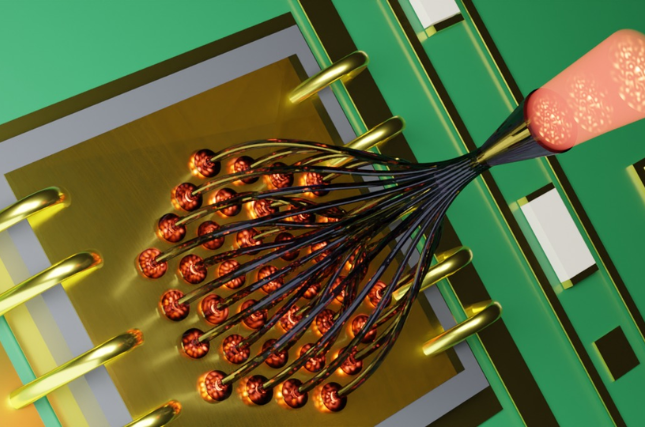
March 16, 2026 – A 3D-printed optical breakthrough that efficiently combines light from dozens of small semiconductor lasers into a single multimode optical fiber with very low loss has been achieved by researchers at the Hebrew University of Jerusalem (HU).
In the new study, published in Nature Communications, the researchers demonstrated the first multimode photonic lanterns that multiplex 7, 19, and 37 multimode Vertical-Cavity Surface-Emitting Lasers (VCSELs) directly into optical fiber while preserving brightness and easing alignment constraints. A photonic lantern is a waveguide device that enables low-loss transition light transfer between a multimode structure and a multicore structure. The technology could simplify and improve high-power laser systems, optical communications, and other photonic applications where efficiently delivering large optical power through fibers is critical.
Traditionally, photonic lanterns were designed for single-mode inputs, making them incompatible with the multimode outputs of high-power VCSEL arrays. The HU team overcame this by designing an adiabatic transition (without heat loss or gain) that converts multiple few-mode sources into a single multimode fiber. Despite their massive-scale capability, these devices are incredibly compact, with the 37-input photonic lantern measuring only 470 µm in length.
This innovation addresses the long-standing challenge of coupling light from large VCSEL arrays into multimode fibers (MMFs) while preserving the brightness and modal system capacity. The research conducted by Ph.D. student Yoav Dana, under the guidance of Professor Dan M. Marom and his team at the HU Institute of Applied Physics, in collaboration with Civan Lasers.
Key Advancements:
- Realization of the first Multimode Photonic Lantern (MM PL): While traditional photonic lanterns interface between multiple single-mode (SM) inputs and a single multimode waveguide, this research successfully realizes a novel “N-MM PL” architecture that supports many multimode VCSEL sources multiplexed into a single high mode count waveguide.
- Massive Scalability: The team successfully demonstrated PLs capable of multiplexing 7, 19, and even 37 VCSEL sources with each lasing across six-spatial modes into a single multimode optical fiber, supporting a total of up to 222 spatial modes.
- High Efficiency at diminutive size: The devices achieved low coupling losses into standard 50 µm multimode fiber, as low as -0.6 dB for 19-input PLs and -0.8 dB for 37-input PLs, with the entire PL requiring less than ½ mm in length, which is many orders of magnitude smaller than competing optical multiplexing system
- Preserved Brightness: Unlike traditional relay lens systems that often diminish beam quality, this “N-MM PL” architecture matches modal capacity to preserve brightness, a critical factor for high-performance optical systems.
The research paper titled “Massive-scale spatial multiplexing of multimode VCSELs with a 3D-printed photonic lantern” is now available in Nature Communications and can be accessed here.
Researchers:
Yoav Dana1, Ksenia Shukhin1, Yehudit Garcia1, Aleksei Kukin1, Baruch Kliot2, Michaela Peer2, Ran Vered2, Ariel Roizman2, and Dan M. Marom1
Institutions:
- Institute of Applied Physics, Hebrew University of Jerusalem
- Civan Lasers Jerusalem