
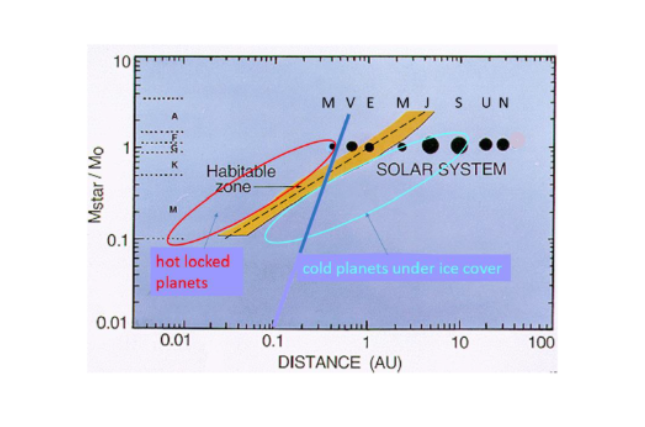
January 26, 2026 – Astronomers have long searched for life within a narrow ring around a star, the “habitable zone,” where a planet should be neither too hot nor too cold for liquid water. However, according to a study by researchers at the Hebrew University of Jerusalem (HU), liquid water could exist far beyond the classical outer edge, hidden beneath ice as subglacial or intraglacial lakes. This means the number of worlds worth checking for water, and potentially life-friendly conditions, may be much larger than the traditional map suggests.
The new study, published in the Astrophysical Journal, indicates that for years, astronomers have relied on the habitable zone rule of thumb when searching for life beyond Earth, planets where liquid water can exist on a planet’s surface. In our own solar system, that zone lies roughly between the orbits of Earth and Mars. But many of the planets now being discovered do not fit neatly into this framework: orbiting stars quite different from our sun, at distances closer than the inner edge of the habitable zone or further out.
Astrophysicist Prof. Amri Wandel from the Hebrew University researched what happens when scientists challenge the assumptions underlying traditional habitability models.
The focus is on tidally locked exoplanets—worlds that always face their star with the same hemisphere. These planets experience permanent daylight on one side and permanent night on the other; a configuration often considered to challenge surface liquid water and life.
Wandel’s analysis suggests otherwise.
Using an analytical climate model that tracks surface temperatures on such planets, the study shows that worlds orbiting M- and K-dwarf stars could sustain liquid water on their night side, even when they orbit significantly closer to their star than classical habitable-zone models allow. Heat transported from the day side can keep parts of the night side above freezing, expanding the range of environments where water may persist.
This extended definition of the habitable zone may help explain recent observations by the James Webb Space Telescope, which detected water vapor and other volatile gases in the atmospheres of warm, close-in Super-Earths orbiting M-dwarf stars—planets previously thought to lie outside the safe range for surface water.
The study also looks in the opposite direction, beyond the outer edge of the habitable zone. Even on cold planets far from their stars, liquid water could exist beneath thick ice layers, in the form of intraglacial lakes or subglacial melting, further widening the habitable zone and enhancing the number of worlds that may support water-based environments by a large factor.
By revisiting the assumptions behind the habitable zone and recalculating its boundaries, this research reframes where astronomers might look for conditions suitable for life, suggesting that potential habitats may exist on planets once ruled out.
The research paper titled “Exoplanets beyond the Conservative Habitable Zone. I. Habitability” is available in The Astrophysical Journal and can be accessed here.
Researchers:
Amri Wandel
Institutions:
The Racah Institute of Physics, Faculty of Science, Hebrew University