December 15, 2025 – Compressing thousands of years into hours, researchers at the Hebrew University of Jerusalem (HU) have, for the first time, created a lab “machine” to capture carbon dioxide, accelerating a natural process.
A new paper published in Environmental Science & Technology, by HU’s Noga Moran and Dr. Yonaton Goldsmith, in addition to Dr. Eyal Wargaft from the Israeli Open University, reveals how limestone, dolomite, and seawater can be used as a natural carbon absorption system and could help reduce emissions from power plants in the future. The new study proposes a method for preventing the release of carbon dioxide from power plants, which could help reduce warming.
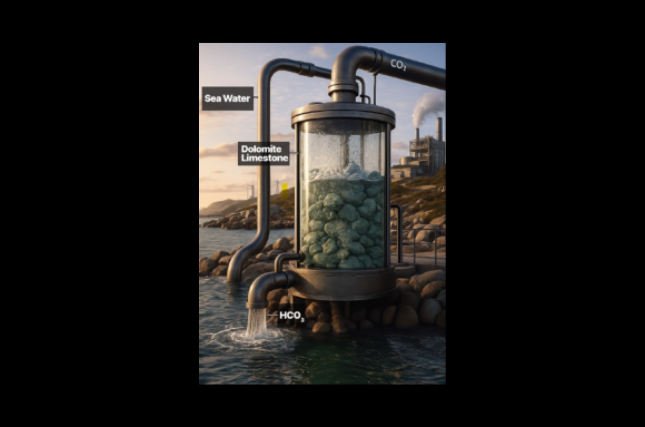
The team demonstrated a controllable method to lock carbon safely in dissolved form, rather than letting it escape into the air by running CO₂ and seawater through columns filled with common rocks. The system currently captures only part of the CO₂, but engineering improvements will result in a practical, nature-based carbon capture technology.
“The goal was to understand what’s really happening when carbonated rocks encounter high levels of carbon dioxide,” says Noga Moran. “Once we figured out the conditions that allowed the process to work efficiently, we could see how something natural and slow becomes a controlled process that can be measured and tuned.”
Mimicking How Earth Dissolves Carbon Dioxide
In nature, carbon dioxide dissolves in rainwater, forming a slightly acidic solution. This water seeps through limestone and dolomite rocks, reacts with them, and forms bicarbonate ions, a dissolved form of carbon, that are carried by rivers to the oceans.
This process is one of the main mechanisms by which the Earth removes carbon dioxide from the atmosphere. However, it occurs at a very slow rate and is limited by the availability of water, carbon dioxide, and the surface area of the rock. On its own, it is far too slow to significantly reduce the intensity of global warming. The current study investigates how this process can be made to happen faster and in a controlled manner, inside a reactor that mimics natural conditions.
A Carbonate Weathering Breakthrough
The researchers designed and built a tall, transparent reactor filled with limestone and dolomite, flowing seawater and carbon dioxide through it to “compress” a very slow natural process, carbonate weathering, into a controlled experiment to demonstrate how this works efficiently in a reactor.
The study shows how this process can be made to work efficiently in a reactor. Among other things, the researchers:
- Identified an optimal CO₂-to-seawater ratio at which the system uses carbon dioxide most efficiently.
- Found that gentle recycling of the gas improves the reaction, while too much circulation actually reduces efficiency.
- Showed that grain size matters: smaller grains lead to more total carbon dissolved, while larger grains create smoother pathways that speed up the reaction rate.
- Demonstrated that dolomite may be a better rock for carbon capture because it does not produce secondary carbonate precipitates that could release carbon back into the atmosphere.
- Measured the system’s overall efficiency: currently, only about 20% of the introduced CO₂ is converted into dissolved carbon, suggesting that engineering improvements could significantly enhance performance.
Together, these findings map out the practical conditions under which a natural carbon capture process can be replicated in the laboratory and turned into an engineering basis for developing future systems to reduce emissions in power plants and industry.
The study is dedicated to Dr. Eyal Wargaft, the initiator of the research and a lecturer at the Open University, who died from cancer during the study.
“Eyal was a brilliant scientist and a great teacher,” says Moran. “He believed that science was part of the solution to the climate crisis, and this work bears his fingerprint at every stage.”
The research paper titled “Maximizing Carbonate Weathering Rates in an Open-System Benchtop Reactor as a Means of CO2 Capture” is now available in Environmental Science & Technology and can be accessed here.
Researchers:
Noga Moran, Eyal Wargaft, Yonaton Goldsmith
Institutions:
- Hebrew University of Jerusalem
- The Israeli Open University